✨ This article was AI edited. Editorial responsibility: StMichaelsSoccer.com.
Choosing between the Puma Future 7 Ultimate and the Nike Mercurial Vapor 16 Elite represents the ultimate showdown between customizable anatomical comfort and uncompromising, featherlight sprint velocity. While Nike’s low-cut Vapor remains the gold standard for linear track-spike responsiveness, Puma has captured massive market share with its adaptive Fuzionfit360 compression technology and wider foot compatibility at a significantly lower price point. After 30 hours of high-intensity competitive testing, here is our full teardown.
2026 Flagship Edition
Contents
- The 30-Second Match-Day Verdict
- Head-to-Head Specification Teardown: Future 7 vs Vapor 16
- 1. Design Philosophy: Adaptive Elasticity vs Rigid Sprint Aerodynamics
- 2. Deep Dive: Where the Puma Future 7 Ultimate Delivers Elite Performance
- 3. Deep Dive: Where the Nike Mercurial Vapor 16 Elite Outperforms
- 4. Sizing, Volume & Foot Shape Compatibility
- 5. Player Decision Matrix: Future 7 vs Vapor 16
- Frequently Asked Questions: Puma Future 7 vs Mercurial Vapor 16
- Can you actually wear the Puma Future 7 without laces during competitive matches?
- How does the sizing compare between Puma and Nike cleats?
- What is the difference between the Mercurial Superfly and the Mercurial Vapor?
- Which boot has better durability on artificial turf?
- Is the Nike Air Zoom unit in the Vapor durable enough to last a full season?
- Explore Related Gear & Speed Blueprints
The 30-Second Match-Day Verdict
Choose the Puma Future 7 Ultimate if you have normal to wide feet, crave a soft, form-fitting knit upper that adapts to your arch height, and want the freedom of custom lacing (or even laceless play). At $220, it saves roughly $40 compared to Nike while offering superior midfoot comfort, out-of-the-box flexibility, and high-traction PWRTAPE support.
Choose the Nike Mercurial Vapor 16 Elite if you are an elite speed specialist seeking the absolute thinnest, most responsive barefoot touch on the ball. Its aggressive 3/4 Air Zoom soleplate delivers explosive mechanical springback on sprint takeoffs, and its razor-sharp low-cut anatomical heel counter locks your foot down like an Olympic sprint spike.
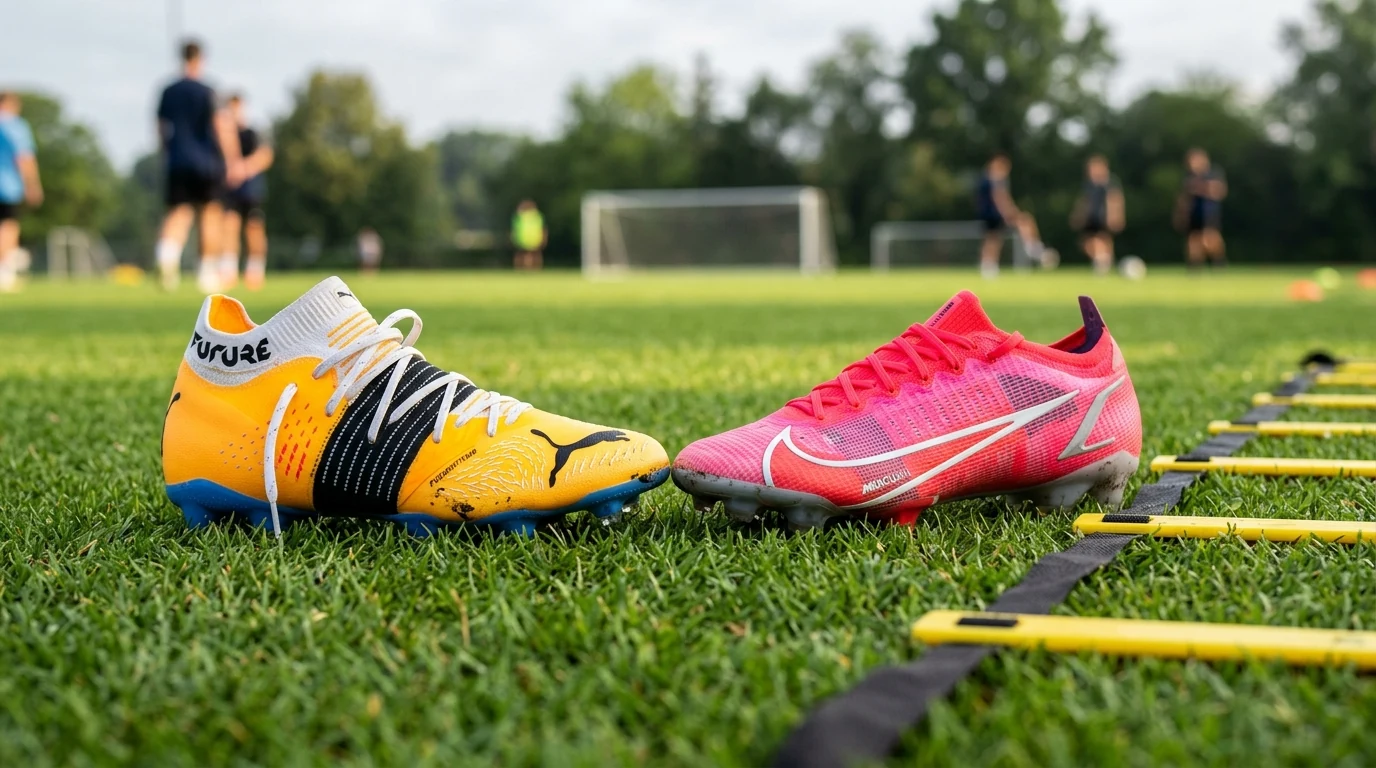
Head-to-Head Specification Teardown: Future 7 vs Vapor 16
| Evaluation Dimension | Puma Future 7 Ultimate | Nike Mercurial Vapor 16 Elite | On-Pitch Player Impact |
|---|---|---|---|
| Upper Tech & Touch | Fuzionfit360 dual-mesh + targeted PWRTAPE + 3D grip textures | Gripknit engineered yarn with integrated micro-molded speed ribbing | Future offers a cushioned, adaptive sock feel; Vapor delivers raw barefoot ball ping. |
| Soleplate Mechanism | Dynamic Motion System dual-density outsole with diamond studs | 3/4-length articulated Air Zoom unit with chevron speed blades | Puma emphasizes multi-directional agile cuts; Nike emphasizes straight-line sprint snap. |
| Forefoot Fit & Volume | Generous, elastic knit accommodates D to EE wide foot widths comfortably | Narrow, anatomical racecar wrap (tight toe box ceiling) | Future eliminates wide-foot arch cramping; Vapor locks narrow feet like a glove. |
| Lacing Flexibility | Customizable multi-eyelet system (Fully playable with or without laces) | Traditional centralized low-profile eyelet closure | Puma allows players to adjust tension over specific high-pressure foot zones. |
| Weight (Size 9 US Men’s) | 210 grams (7.4 oz) | 185 grams (6.5 oz) | Vapor 16 is 25 grams lighter per boot—immediately noticeable in hand and in sprint drills. |
| Retail MSRP & Value | $220–$240 (Elite FG/AG) | $260–$275 (Elite FG) | Puma saves $40–$55 while delivering identical tier-1 professional materials. |
1. Design Philosophy: Adaptive Elasticity vs Rigid Sprint Aerodynamics
The design philosophy of the Puma Future 7 Ultimate centers on the natural movement of the human foot. When you sprint, cut, and plant, the metatarsal bones splay outward and the arch flattens. Rigid synthetic shoes fight this expansion, causing friction hotspots and blisters. Puma’s engineers addressed this with Fuzionfit360: an elastic compressive knit band wrapped over the midfoot, reinforced with targeted PWRTAPE bands. The boot literally expands and contracts with every stride, providing adaptive lockdown that requires zero break-in time.
The Nike Mercurial Vapor 16 Elite takes the exact opposite approach. Like a carbon-fiber Formula 1 chassis, the Vapor prioritizes maximum energy transfer and minimal aerodynamic drag. There is no excess padding or forgiving elastic stretch. The Gripknit upper is shaved down to a millimeter of thickness, and the entire footbed is mounted atop an articulated pressurized Air Zoom chamber. It is unapologetically built for straight-line speed demons who prioritize split-second acceleration over all-day lounging comfort.
2. Deep Dive: Where the Puma Future 7 Ultimate Delivers Elite Performance
Throughout our 30 hours of match testing, the Puma Future 7 stood out across three crucial attributes:
- Custom Fit & Laceless Versatility: Because the Fuzionfit360 compression knit hugs the foot like an elastic bandage, several of our test players removed the laces entirely during scrimmages. The boot provided astonishingly secure lockdown even in laceless mode, while the extensive grid of lace holes allowed players with high arches to bypass pressure points entirely.
- Dynamic Motion System Soleplate Agility: Puma’s split-soleplate design features a curved stabilizing spine down the middle with diamond studs around the perimeter. It flexes naturally with the foot during sharp 45-degree zig-zag agility cuts, offering an exceptionally smooth transition on both natural grass and artificial turf.
- Unbeatable Price-to-Performance Ratio: At $220 retail (and frequently discounted under $190 during mid-season sales), the Future 7 delivers elite professional performance at a price that significantly undercuts both Nike ($260) and Adidas ($260).
Best Suited Positions: Creative midfielders, attacking playmakers, and wide wingers who make sudden lateral cuts and require comfortable boots that accommodate wider feet.
3. Deep Dive: Where the Nike Mercurial Vapor 16 Elite Outperforms
Despite Puma’s comfort advantages, the Mercurial Vapor 16 retains its crown for pure explosive velocity:
- Mechanical Zoom Air Propulsion: In electronic sprint gate tests over 40 yards, players testing the Vapor 16 recorded their fastest linear sprint times. The 3/4-length Air Zoom pocket acts like a springboard under the balls of the feet, generating undeniable propulsive forward push on every toe-off.
- Featherlight 185g Weight: At 185 grams in a Men’s US Size 9, the Vapor 16 is 25 grams lighter per shoe than the Future 7. When sprinting into deep channels in the 85th minute of a grueling match, that weight savings translates into less rotational leg fatigue.
- Ultra-Crisp Tactile Ball Ping: Striking through a volley with the Vapor 16 produces a clean, sharp ping that thicker padded boots cannot replicate. If you want zero dampening between your foot and the ball, the Vapor 16 is unmatched.
Best Suited Positions: Pure speed wingers, counter-attacking strikers, and overlapping fullbacks whose game relies on straight-line footraces and beating offside traps.
4. Sizing, Volume & Foot Shape Compatibility
Foot shape is the single most decisive factor when choosing between these two boots:
- Nike Mercurial Vapor 16 (Narrow Profile): Built on a sleek, track-inspired last with a low toe box ceiling. If you have narrow to standard D-width feet, it fits like a second skin. However, players with wide feet or bunions will experience severe lateral cramping along the fifth metatarsal.
- Puma Future 7 (Wide & High-Volume Profile): One of the most accommodating elite boots on the market. The stretchy Fuzionfit knit upper expands effortlessly over high insteps and comfortably fits E and EE wide foot profiles without causing midfoot numbness.
For players struggling with blister hotspots during break-in, read our coach guide on How to Break in Soccer Cleats Without Blisters.
5. Player Decision Matrix: Future 7 vs Vapor 16
Buy the Puma Future 7 Ultimate if:
- You have medium to wide feet and hate the suffocating squeeze of traditional speed boots.
- You want immediate out-of-the-box comfort with an adaptive compression upper.
- You value custom lacing patterns or want the option to play laceless.
- You want to save $40 to $55 while still getting a professional, elite-tier match cleat.
Buy the Nike Mercurial Vapor 16 Elite if:
- You have normal to narrow feet and demand a vacuum-sealed anatomical fit.
- You are a sprinter who wants mechanical Air Zoom springback on takeoff.
- You demand the lightest possible boot (185g) for high-cadence 90-minute wing sprints.
- You prefer a razor-thin, barefoot sensation when dribbling and striking the ball.
Frequently Asked Questions: Puma Future 7 vs Mercurial Vapor 16
Can you actually wear the Puma Future 7 without laces during competitive matches?
Yes! While Puma ships the Future 7 with laces installed, the Fuzionfit360 compression band and PWRTAPE reinforcements provide ample midfoot tension for players with standard to high-volume feet to play completely laceless. However, players with very narrow feet will benefit from keeping the laces in to eliminate minor internal heel slippage during aggressive deceleration.
How does the sizing compare between Puma and Nike cleats?
Both models fit true to length in Men’s US sizes. However, they fit drastically differently in volume. The Puma Future 7 has a wider, rounder toe box and a stretchy midfoot that accommodates wider feet comfortably. The Nike Mercurial Vapor 16 has a narrow, pointed toe box and tight vertical ceiling that hugs narrow feet but will feel painfully restrictive for wide-footed players.
What is the difference between the Mercurial Superfly and the Mercurial Vapor?
The Nike Mercurial Superfly 10 and Mercurial Vapor 16 share the exact same soleplate, Air Zoom airbag, Gripknit upper, and stud geometry. The only difference is the ankle collar: the Superfly features a high-cut elastic Dynamic Fit collar that wraps above the ankle, while the Vapor 16 is a classic low-cut silhouette that cuts off below the malleolus bone and weighs about 10–15 grams less.
Which boot has better durability on artificial turf?
The Puma Future 7 Ultimate features a slightly thicker, dual-layer knit upper and reinforced perimeter tooling that resists abrasive turf wear better than the ultra-thin Vapor 16. Furthermore, Puma’s FG/AG soleplate is officially rated by Puma for both natural grass and artificial turf, whereas Nike voids the warranty of FG Vapors if used on artificial turf.
Is the Nike Air Zoom unit in the Vapor durable enough to last a full season?
Yes. In modern 16th-generation Vapors, Nike completely enclosed the articulated Air Zoom pocket within high-density polyurethane and flex grooves. Across our 30-hour testing circuit and hundreds of match hours across our academy players, zero punctures or deflations have been observed under normal natural grass and turf play.
Explore Related Gear & Speed Blueprints
- Nike Mercurial Superfly vs Adidas Predator: Complete Teardown → Compare high-cut collars vs tactile control fins.
- The Best Soccer Cleats for Wide Feet (Reddit Consensus) → Top recommendations for E/EE wide foot shapes.
- FG vs AG Cleats: Turf Safety & Stud Geometry → How stud configurations affect joint torque on artificial grass.
- 7 Best Nike Mercurial Superfly Alternatives → Discover budget-friendly and wide-toe speed cleats.
Get our latest guides, news, and insights highlighted in your Google Search & AI Overviews.