✨ This article was AI edited. Editorial responsibility: StMichaelsSoccer.com.
Wearing the wrong stud configuration on modern artificial turf is the single most common—and preventable—cause of severe lower-extremity injuries in soccer. While elite players look spectacular sprinting in razor-sharp Firm Ground (FG) chevron cleats on pristine natural grass, stepping onto a 3G or 4G rubber-infill turf field with those same blades turns your footwear into a mechanical trap. Below is our complete biomechanical teardown of Firm Ground (FG) bladed outsoles versus Artificial Grass (AG) conical plates, backed by rotational friction data and joint safety protocols.
Biomechanical Standard
Contents
- The 30-Second Match-Day Safety Rule
- Engineering & Biomechanical Matrix: FG vs AG Stud Outsoles
- 1. The Biomechanics of Stud Lock: Why Knees Tear on Turf
- 2. How Artificial Grass (AG) Outsoles Eliminate Rotational Snagging
- 3. The Durability Trap: Turf Burn and Soleplate Separation
- 4. Pitch-to-Plate Selection Guide: Mapping Your Match Surfaces
- Frequently Asked Questions: FG vs AG Cleats
- Why do professional soccer players wear FG cleats on artificial grass?
- Can I wear Artificial Grass (AG) cleats on natural grass?
- What is the difference between AG (Artificial Grass) and TF (Turf) shoes?
- Why do major brands void cleat warranties if worn on artificial turf?
- What are Multi-Ground (MG) cleats and are they safe?
- Explore Related Gear & Field Safety Blueprints
The 30-Second Match-Day Safety Rule
Never wear aggressive chevron or bladed FG studs on 3G/4G artificial grass. Long, bladed studs penetrate deeply into rubber crumb infill and fail to release when you pivot, transferring extreme rotational torque directly into your knee ligaments (ACL/MCL) and ankle mortise. Furthermore, wearing FG boots on artificial grass automatically voids manufacturer warranties.
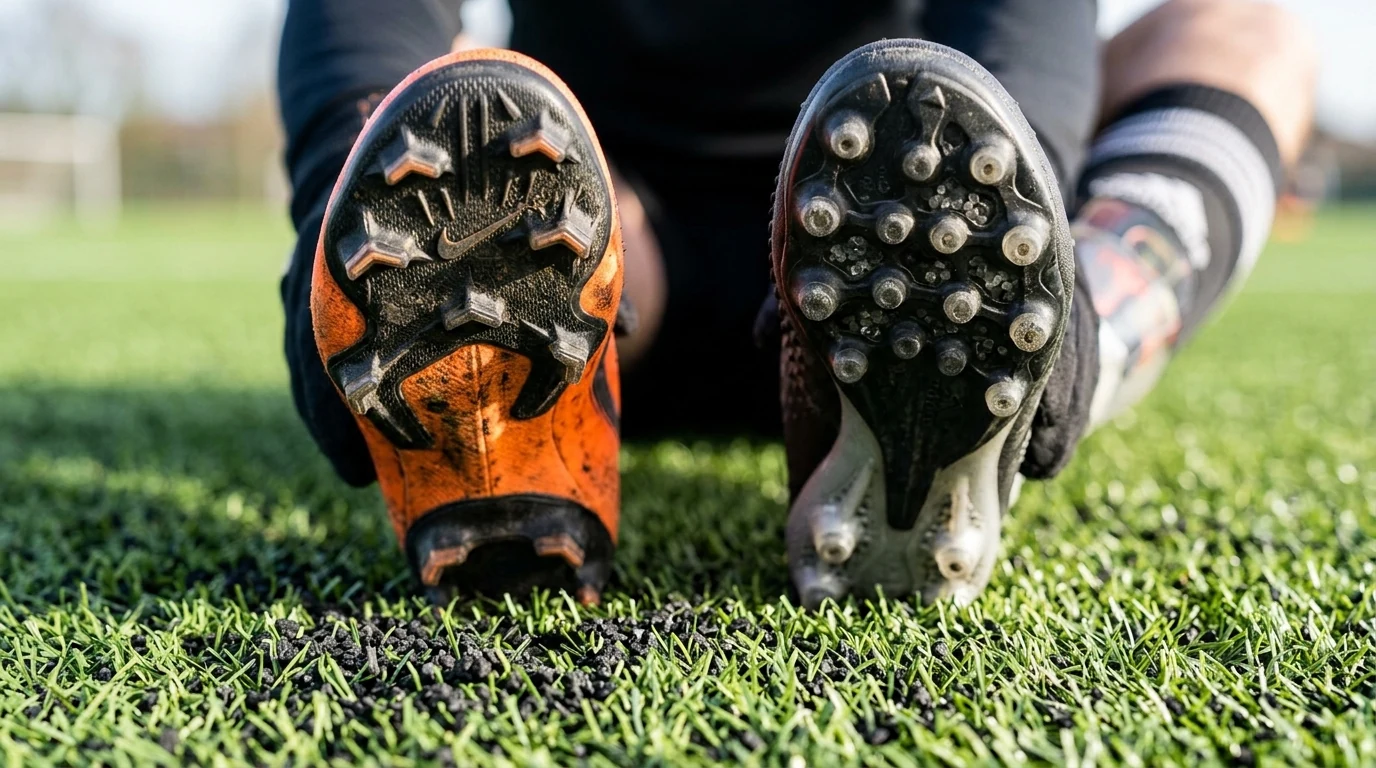
Invest in dedicated AG (Artificial Grass) boots featuring a high count of shorter, circular, hollow conical studs. Conical studs allow the boot to pivot smoothly 360 degrees within synthetic fibers without snagging, distribute body weight evenly across the footbed to prevent metatarsal pain, and resist high frictional heat.
Engineering & Biomechanical Matrix: FG vs AG Stud Outsoles
| Evaluation Dimension | Firm Ground (FG) Outsole | Artificial Grass (AG) Outsole | Biomechanical & Safety Impact |
|---|---|---|---|
| Stud Geometry & Count | 11–13 aggressive blades, chevrons, or sharp triangles (13–15mm length) | 18–24 short, circular, hollow conical studs (8–10mm length) | AG provides 360-degree rotational release; FG creates high rotational drag. |
| Rotational Torque on Turf (Nm) | Exceeds 55–65 Nm during 90-degree cutting maneuvers | Maintains safe rotational release under 32–38 Nm | Rotational torque >45 Nm significantly increases non-contact ACL strain. |
| Footbed Pressure Distribution | Concentrated pressure across few contact points (Causes ‘stud pressure’) | Even weight dispersion across 20+ contact points | AG completely eliminates forefoot bruising and plantar fascia inflammation on hard turf. |
| Friction Heat & Delamination | High thermal build-up; rubber infill friction melts toe-box adhesive | Reinforced TPU toe bumper and heat-resistant polyurethane bonding | FG boots split at the toe within 6–10 weeks on turf; AG lasts multiple seasons. |
| Manufacturer Warranty Status | VOIDED by Nike, Adidas, and Puma if used on artificial turf | FULL COVERAGE under standard manufacturer defects warranty | Retailers reject return claims for split FG boots showing black turf crumb stains. |
1. The Biomechanics of Stud Lock: Why Knees Tear on Turf
To understand why Firm Ground studs are dangerous on synthetic turf, you must examine how artificial surfaces react to impact. Natural grass is an organic shear surface: when a player plants their foot and rotates violently, the grass roots and topsoil release, tearing away in small divots. This soil yield acts as a natural mechanical fuse, dissipating excess torque before it travels into the human skeleton.
Modern 3G and 4G artificial turf fields consist of polypropylene fiber carpets infilled with millions of tiny recycled rubber crumb pellets and silica sand. Rubber pellets do not shear away like dirt; instead, when a long, bladed chevron stud drives into the carpet, the rubber infill compacts around the sharp edges of the blade. When the athlete attempts to pivot their torso, the foot remains locked into the turf carpet.
With the foot anchored to the ground and the body continuing its rotational momentum, the kinetic energy has nowhere to go except into the knee joint. The resulting valgus collapse and internal tibial rotation places catastrophic tensile loads on the Anterior Cruciate Ligament (ACL) and meniscus. Sports biomechanics laboratories consistently record peak rotational resistance exceeding 60 Newton-meters (Nm) for bladed FG boots on dry turf—well above the clinical threshold for non-contact ligament failure.
2. How Artificial Grass (AG) Outsoles Eliminate Rotational Snagging
Footwear engineers developed dedicated AG plates with specific geometric countermeasures:
- Hollow Conical Stud Geometry: Conical studs are symmetrical cylinders. Because they have no sharp angular edges, they can rotate in a circle through compacted rubber infill with zero directional resistance. The hollow core allows rubber crumb to compress inside the stud momentarily and evacuate freely without packing into a hard mass.
- Reduced Stud Height (8mm–10mm): FG studs typically measure 13mm to 15mm in the heel and 11mm in the forefoot. On artificial turf, where the infill depth is often only 20mm to 30mm, tall studs bottom out against the concrete or compacted stone sub-base. AG studs are engineered 30% shorter, preventing the sensation of running on stilts.
- High Stud Count (18 to 24 Studs): By increasing the total number of studs across the soleplate, player weight is distributed across twice as many contact points. This completely eliminates stud pressure hotspots that cause painful bone bruising under the metatarsals.
3. The Durability Trap: Turf Burn and Soleplate Separation
Beyond joint safety, wearing FG boots on artificial grass destroys expensive cleats in record time. Artificial turf fibers are made of polyethylene and nylon plastic. During a 90-minute match, the friction between a cleat’s toe box and these plastic fibers generates local surface temperatures exceeding 130°F (55°C).
Standard FG cleats use flexible polyurethane adhesives formulated for moist, cool natural grass. The abrasive heat of turf degrades this glue, causing the front soleplate lip to separate from the upper within 6 to 10 weeks of regular play. In contrast, authentic AG boots feature:
- An extended rubber or TPU toe bumper wrapped over the front lip.
- Heavy-duty perimeter vulcanization to resist abrasive sand and infill wear.
- Full manufacturer warranty protection against soleplate delamination.
4. Pitch-to-Plate Selection Guide: Mapping Your Match Surfaces
Follow This Simple Surface Audit:
- 100% Natural Grass (Firm/Dry Soil): Wear Firm Ground (FG). Maximum propulsion, aggressive bite, and zero joint danger because natural soil yields.
- 70%+ 3G/4G Artificial Turf: Buy dedicated Artificial Grass (AG). Essential for ACL protection, knee longevity, and footwear warranty.
- 50/50 Split (Grass & Turf on One Budget): Look for dedicated Multi-Ground (MG) or rounded-stud FG models (such as the Adidas Copa Pure with conical studs). Avoid aggressive chevron blades like the Mercurial Superfly on turf.
- Old-School Short Carpet / AstroTurf (2G Sand): Wear Turf (TF) shoes with small multi-directional rubber nubs. Cleated studs should never be worn on sand-filled 2G carpet.
Frequently Asked Questions: FG vs AG Cleats
Why do professional soccer players wear FG cleats on artificial grass?
Professional players occasionally wear custom-modified boots or have access to multi-million-dollar athletic training and surgical staffs. More importantly, top European stadiums install hybrid grass (95% natural grass stitched with 5% synthetic fibers), which behaves like natural turf and is completely different from amateur 3G/4G community rubber-crumb pitches. For non-professional athletes paying their own medical bills, risking ACL tears in FG boots on artificial turf is completely unjustified.
Can I wear Artificial Grass (AG) cleats on natural grass?
Yes! Conical AG cleats perform exceptionally well on dry, firm natural grass. Because conical studs penetrate dry soil easily, you will experience dependable grip without excessive bite. However, on wet, muddy, or deeply saturated natural pitches, the shorter AG studs will not bite deep enough into the mud, causing you to slip.
What is the difference between AG (Artificial Grass) and TF (Turf) shoes?
AG boots feature molded plastic conical studs (8–10mm) designed for thick 3G/4G fields that have long synthetic grass fibers and deep rubber crumb infill. TF shoes feature a flat rubber outsole with dozens of tiny rubber nubs (3–5mm) and a foam EVA midsole, designed for short-pile carpet, indoor turf centers, and older sand-dressed 2G pitches.
Why do major brands void cleat warranties if worn on artificial turf?
Brands like Nike and Adidas explicitly state that FG boots are engineered solely for natural grass. The extreme frictional heat, abrasive sand, and compacted rubber infill of artificial turf pull at the bonded perimeter of the soleplate with forces 3 to 4 times higher than grass. When consumers return split FG cleats with black rubber pellets stuck inside the adhesive, manufacturers immediately deny the warranty claim.
What are Multi-Ground (MG) cleats and are they safe?
Multi-Ground (MG) cleats are hybrid soleplates engineered by manufacturers (especially Puma and Adidas) to perform safely on both natural grass and artificial turf. They feature an intermediate stud count with rounded, low-profile shapes that pass rotational friction safety standards while offering adequate bite on natural sod. They are an excellent budget-conscious choice for youth players who switch surfaces weekly.
Explore Related Gear & Field Safety Blueprints
- The Ultimate Stud Selection Guide: FG vs AG vs SG vs Turf → Comprehensive pitch-condition decision tree.
- Nike Phantom GX vs Adidas Copa Pure: Field Teardown → Conical soleplate performance on dry turf pitches.
- Why Cheap Soccer Cleats Hurt Your Feet (Reddit Consensus) → The link between stiff plastic soleplates and metatarsal pain.
- Do Soccer Grip Socks Actually Work? → Eliminating internal boot sliding and blister hotspots.
Get our latest guides, news, and insights highlighted in your Google Search & AI Overviews.