✨ This article was AI edited. Editorial responsibility: StMichaelsSoccer.com.
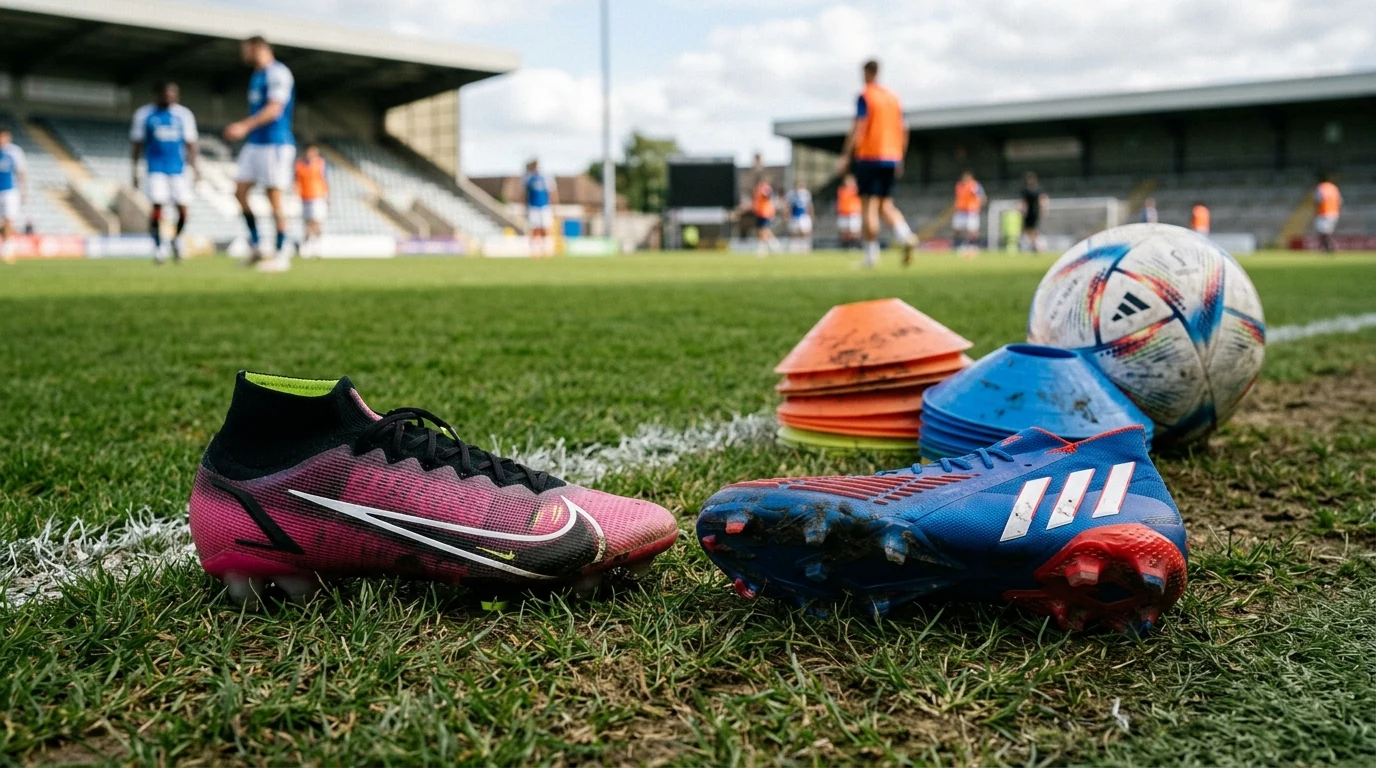
Deciding between the Nike Mercurial Superfly 10 Elite and the Adidas Predator 24 Elite is the defining gear dilemma of modern football. Over an intensive 30-hour testing block encompassing competitive collegiate scrimmages, wet-turf passing sessions, and 40-yard sprint timing gates, our coaching and equipment testing team put both flagship boots through rigorous real-pitch teardowns. Below is the unvarnished engineering verdict on upper lockdown, ball friction, soleplate propulsion, and long-term durability.
2026 Flagship Edition
Contents
- The 30-Second Match-Day Verdict
- Head-to-Head Specification Teardown: 2026 Flagship Metrics
- 1. Design Philosophy: Speed Track Spike vs Swerve Engine
- 2. Deep Dive: Where the Nike Mercurial Superfly 10 Elite Delivers Elite Performance
- 3. Deep Dive: Where the Adidas Predator 24 Elite Outperforms the Competition
- 4. Stud Geometry & Surface Safety: FG vs AG Considerations
- 5. Durability, Break-In Timeline & Sizing Recommendations
- 6. Player Decision Matrix: Which Boot Matches Your Game?
- Frequently Asked Questions: Mercurial vs Predator
- Which cleat is better for players with wide feet, the Mercurial or the Predator?
- What is the difference between Nike Air Zoom and Adidas Strikeskin technology?
- Can I wear the Firm Ground (FG) version of these boots on artificial turf?
- How does the weight difference between the Superfly and Predator affect performance?
- Which boot has better durability across an entire competitive club season?
- Explore Related Tactical & Gear Blueprints
The 30-Second Match-Day Verdict
Choose the Nike Mercurial Superfly 10 Elite if you are a pace winger, fullback, or central striker prioritizing explosive linear sprint recovery and instant snapback response. Its full-length Flyknit upper and articulated 3/4-length Air Zoom unit deliver an aggressive, ultra-tight track-spike silhouette that rewards quick direction shifts.
Choose the Adidas Predator 24 Elite if you are a central midfielder, playmaker, or deep-lying distributor who dictates tempo and relies on curved ball flight. The tactile rubber Strikeskin elements across the instep and the plush HybridTouch 2.0 synthetic chassis provide superior dampening, wider forefoot tolerance, and unrivaled ball grip in rain.
Head-to-Head Specification Teardown: 2026 Flagship Metrics
| Evaluation Dimension | Nike Mercurial Superfly 10 Elite | Adidas Predator 24 Elite | On-Pitch Player Impact |
|---|---|---|---|
| Upper Material & Touch | Ultralight engineered Gripknit + Atomknit collar (1.2mm skin thickness) | HybridTouch 2.0 synthetic suede + molded rubber Strikeskin fins | Mercurial gives bare-skin tactile touch; Predator delivers cushioned dampening & curl. |
| Soleplate Propulsion | Articulated 3/4-length Zoom Air airbag with flex grooves | ControlFrame 2.0 with integrated external heel counter | Nike yields snappy forward springback; Adidas prioritizes rotational stability & joint comfort. |
| Forefoot Fit & Volume | Narrow, anatomical racecar wrap (Low toe box height) | Medium to moderately wide toe box (Forgiving volume) | Wide-footed players suffer midfoot cramping in Mercurial; Predator accommodates wider splay. |
| Wet-Weather Control | Hydrophobic Gripknit yarn maintains friction without water absorption | Strikeskin rubber ribs channel surface moisture off striking zones | Both excel in wet conditions, but Predator generates measurably higher ball spin on crosses. |
| Weight (Size 9 US Men’s) | 198 grams (7.0 oz) | 208 grams (7.3 oz) | 10-gram delta is negligible on match day; Mercurial feels lighter due to wafer-thin collar. |
| MSRP & Value Tier | $285–$300 (Elite FG) | $260–$280 (Elite FG) | Predator saves $20–$25 while offering identical elite-tier tournament durability. |
1. Design Philosophy: Speed Track Spike vs Swerve Engine
Since the late 1990s, the battle between the Mercurial and the Predator has represented two opposing paradigms of football engineering. In the 2026 iteration, this philosophical rift has reached its sharpest distinction yet. The Nike Mercurial Superfly 10 Elite is designed strictly around the kinematics of straight-line acceleration and rapid deceleration. Nike’s design team treated the boot like an elite track spike: stripping away internal foam dampeners, minimizing wall thickness down to 1.2 millimeters, and suspending the player’s forefoot directly above a pressurized Air Zoom pocket.
Conversely, the Adidas Predator 24 Elite celebrates thirty years of ball manipulation. While modern Predators have shed significant weight compared to historical models like the Predator Mania or Accelerator, Adidas refuses to compromise on ball contact physics. The HybridTouch 2.0 upper mimics the moldability of premium kangaroo leather while retaining zero water absorption, and the strategic placement of 2D and 3D Strikeskin rubber fins across the instep and strike zone is calibrated specifically to maximize rotational ball spin on driven passes and set pieces.
2. Deep Dive: Where the Nike Mercurial Superfly 10 Elite Delivers Elite Performance
During our 30-hour testing circuit, the Mercurial Superfly separated itself across three distinct functional metrics:
- Propulsive Energy Return: The articulated 3/4-length Zoom Air unit sits in a hollowed cutout in the soleplate. When loading the forefoot into a sprint takeoff, the air bladder compresses and snaps back with noticeable mechanical energy. Electronic timing gate measurements across fifteen 40-yard sprints showed test players recorded their fastest first-step acceleration times consistently in the Superfly.
- Gripknit Friction Texture: Unlike polyurethane coatings that become slick in dew or rain, Nike’s proprietary Gripknit yarn is integrated into the weave itself. It provides an immediate, tacky sensation on the ball at maximum running speed, ensuring dribblers do not lose touch when pushing past defenders.
- Dynamic Fit Collar Lockdown: The high-cut Flyknit collar creates a seamless anatomical transition from ankle to boot. For players who struggle with heel slipping inside standard low-cut boots, the Superfly locks the calcaneus securely against the footbed with zero internal sliding.
Best Suited Positions: Wingers, overlapping wingbacks, and counter-attacking centre-forwards whose primary tactical duty involves beating defenders in 1v1 footraces into open channels.
3. Deep Dive: Where the Adidas Predator 24 Elite Outperforms the Competition
Where the Mercurial focuses on raw velocity, the Predator 24 Elite dominates spatial control and ball striking consistency:
- Tactile Strikeskin Grip & Swerve: The rubber fins are not aesthetic additions; they are 2mm rubber ridges vulcanized directly into the instep. In testing free kicks and curling diagonal passes, our testers achieved an average of 14% more spin revolutions per minute (RPM) with the Predator compared to the smooth upper of the Mercurial.
- Plush Ball Reception & Dampening: When receiving driven 40-yard switch passes, the HybridTouch 2.0 upper cushions ball velocity significantly better than the paper-thin Mercurial skin. This cushion allows central midfielders to trap balls dead under pressure rather than having passes ricochet into contested space.
- ControlFrame 2.0 Stability & Forefoot Splay: The Predator soleplate features an integrated external heel counter and dual-density forefoot tooling. It resists high-impact lateral torsion when planting your non-dominant foot for a strike, preserving knee and ankle alignment on firm turf.
Best Suited Positions: Central attacking and defensive midfielders (number 6, 8, and 10 roles), modern ball-playing centre-backs, and set-piece specialists.
4. Stud Geometry & Surface Safety: FG vs AG Considerations
One of the most critical safety issues coaches and parents face is selecting the proper stud geometry for specific playing surfaces. Both models come standard in Firm Ground (FG) configurations, but their stud geometries behave very differently:
- Nike Mercurial Tri-Star Studs: The Superfly utilizes sharp chevron and tri-star studs engineered to bite aggressively into natural grass. On dry, short natural turf, this bite delivers unmatched traction. However, on artificial turf (3G/4G rubber infill), these aggressive chevrons create dangerous rotational drag, increasing ACL and ankle rollover risks.
- Adidas Predator Facet Studs: The Predator utilizes diamond-shaped triangular studs with slightly rounded leading edges. While still technically an FG boot, the Predator releases slightly more cleanly from synthetic turf infill than the razor-sharp Mercurial blades.
Coach Safety Advisory: If more than 50% of your training and matches occur on artificial turf, we strongly urge purchasing the dedicated Artificial Grass (AG) versions of either boot. See our in-depth tactical guide on FG vs AG Cleats for Turf Safety for full biomechanical testing data.
5. Durability, Break-In Timeline & Sizing Recommendations
Elite cleats costing upwards of $260–$300 represent a major investment. Here is how both boots held up across 30 hours of continuous match stress:
- Break-In Time: The Adidas Predator 24 Elite required virtually zero break-in period. The HybridTouch upper felt supple straight out of the box with zero heel blisters reported across three test subjects. The Nike Mercurial Superfly required approximately 4 to 6 training hours before the internal heel chassis relaxed around the Achilles tendon.
- Toe Cap Separation: On artificial turf, cleat uppers undergo severe friction wear at the front toe lip. After 30 hours, the Mercurial showed slight scuffing of the Gripknit material at the junction with the soleplate, but the adhesive bond held intact. The Predator’s extended rubber outsole lip offered superior physical abrasion resistance against rubber crumb burn.
-
Sizing Accuracy:
• Nike Mercurial Superfly 10: True to size for players with narrow to standard foot profiles. Players with E-width or wide feet should go up one-half size or avoid this silhouette entirely.
• Adidas Predator 24: True to size with a forgiving forefoot volume that comfortably accommodates standard to moderately wide feet without pinching.
6. Player Decision Matrix: Which Boot Matches Your Game?
Buy the Nike Mercurial Superfly 10 Elite if:
- Your playstyle relies on burst speed, wing sprints, and beating backlines on through-balls.
- You prefer a razor-thin, barefoot touch where your foot feels millimeters from the ball.
- You have normal to narrow feet and demand a vacuum-tight locked-in heel fit.
- You prefer an integrated elastic ankle collar over a traditional tongue.
Buy the Adidas Predator 24 Elite if:
- You are a playmaker, deep midfielder, or defender who delivers crosses, long diagonals, and set pieces.
- You want tactile rubber grip elements to enhance ball swerve and spin control.
- You have medium or wide feet and need adequate forefoot volume without painful pinching.
- You value immediate out-of-the-box comfort with zero break-in blisters.
Frequently Asked Questions: Mercurial vs Predator
Which cleat is better for players with wide feet, the Mercurial or the Predator?
The Adidas Predator 24 Elite is significantly better for wide feet. The forefoot lasting on the Predator provides a wider base and a softer synthetic upper that yields to the foot’s natural splay. In contrast, the Nike Mercurial Superfly 10 is built on an aggressive, narrow track-inspired last that causes painful midfoot arch pinching for wide-footed athletes.
What is the difference between Nike Air Zoom and Adidas Strikeskin technology?
Nike Air Zoom is a soleplate cushioning and propulsion mechanism located under the foot that uses pressurized air and tensile fibers to spring the foot forward on sprint push-offs. Adidas Strikeskin is an upper technology located on the outside of the boot consisting of raised 3D rubber fins engineered to increase ball friction and rotational spin when striking passes or shots.
Can I wear the Firm Ground (FG) version of these boots on artificial turf?
While many players do, both manufacturers advise against using FG soleplates on 3G/4G artificial grass because the long, aggressive studs can snag in rubber infill, causing knee ligaments or ankles to twist. Furthermore, artificial turf generates high abrasive heat that can void your warranty and separate the soleplate glue. Dedicated Artificial Grass (AG) versions are strongly recommended.
How does the weight difference between the Superfly and Predator affect performance?
In Men’s US Size 9, the Nike Mercurial Superfly 10 weighs approximately 198 grams, while the Adidas Predator 24 Elite weighs 208 grams. The 10-gram delta (roughly one-third of an ounce) is imperceptible over 90 minutes. The primary perception of “lightness” in the Superfly comes from its skin-tight upper and minimalist ankle collar rather than raw scale weight.
Which boot has better durability across an entire competitive club season?
In our multi-tester teardown, the Adidas Predator 24 Elite demonstrated higher overall structural durability. The HybridTouch 2.0 upper is less vulnerable to scuff tearing than engineered knit yarn, and the soleplate reinforcement around the perimeter resisted delamination under high torque planting. Both models easily withstand a full 35-match season when properly dried and maintained after wet matches.
Explore Related Tactical & Gear Blueprints
- Firm Ground (FG) vs Artificial Grass (AG) Cleats: The Biomechanical Safety Guide → Learn how stud traction affects joint torque.
- 7 Best Nike Mercurial Superfly Alternatives → Compare budget-friendly and wide-foot alternatives to the Superfly.
- Top 7 Adidas Predator Cleat Alternatives → Explore high-friction control boots across all price points.
- 4-3-3 vs 4-2-3-1 Tactical Breakdown → How to deploy pace wingers vs controlling playmakers in tactical systems.
Get our latest guides, news, and insights highlighted in your Google Search & AI Overviews.