✨ This article was AI edited. Editorial responsibility: StMichaelsSoccer.com.
The modern tactical divide between the 4-3-3 single-pivot system and the 4-2-3-1 double-pivot system represents the most critical strategic choice facing coaches today. While both formations deploy four defenders and prioritize possession-based territory control, their structural geometry dictates completely distinct passing networks, pressing traps, and defensive transition vulnerabilities. Drawing from match-film breakdowns, tracking data, and grassroots training sessions, here is the definitive operational teardown of both systems.
2026 Strategic Blueprint
Contents
- The 30-Second Tactical Decision
- Tactical Dimensions: 4-3-3 vs 4-2-3-1 Comparative Matrix
- 1. Structural Geometry: Inverted Triangle vs Flat-Base Double Pivot
- 2. Deep Dive: Where the 4-3-3 Dominates the Pitch
- 3. Deep Dive: Where the 4-2-3-1 Provides Superior Balance & Security
- 4. Pressing Triggers: High-Block Lock vs Mid-Block Trap
- 5. Coach Selection Matrix: Which System Fits Your Squad?
- 6. In-Game Fluidity: How Modern Coaches Transition 4-3-3 into 4-2-3-1
- Frequently Asked Questions: 4-3-3 vs 4-2-3-1
- What is the primary difference between a 4-3-3 and a 4-2-3-1 formation?
- Which formation is better for youth soccer development (U11 to U16)?
- Can a 4-3-3 beat a 4-2-3-1 head-to-head?
- What physical attributes does a single pivot (#6) need in a 4-3-3?
- How do fullbacks play differently in a 4-3-3 versus a 4-2-3-1?
- Explore Related Tactical & Coaching Blueprints
The 30-Second Tactical Decision
Select the 4-3-3 Formation if your squad possesses an elite, press-resistant defensive midfielder (a true #6 single pivot) capable of shielding both center-backs solo, paired with dynamic box-to-box central midfielders (#8s) who aggressively attack the opposition half-spaces. This system maximizes wide 1v1 wing isolations and high-tempo counter-pressing.
Select the 4-2-3-1 Formation if your team needs greater structural security in defensive transition and features a specialized creative playmaker (a true #10 central attacking midfielder) operating behind the striker. The double-pivot (two #6/#8 holding midfielders) provides an automatic defensive insurance policy against counter-attacks and allows fullbacks to overlap without leaving central avenues exposed.
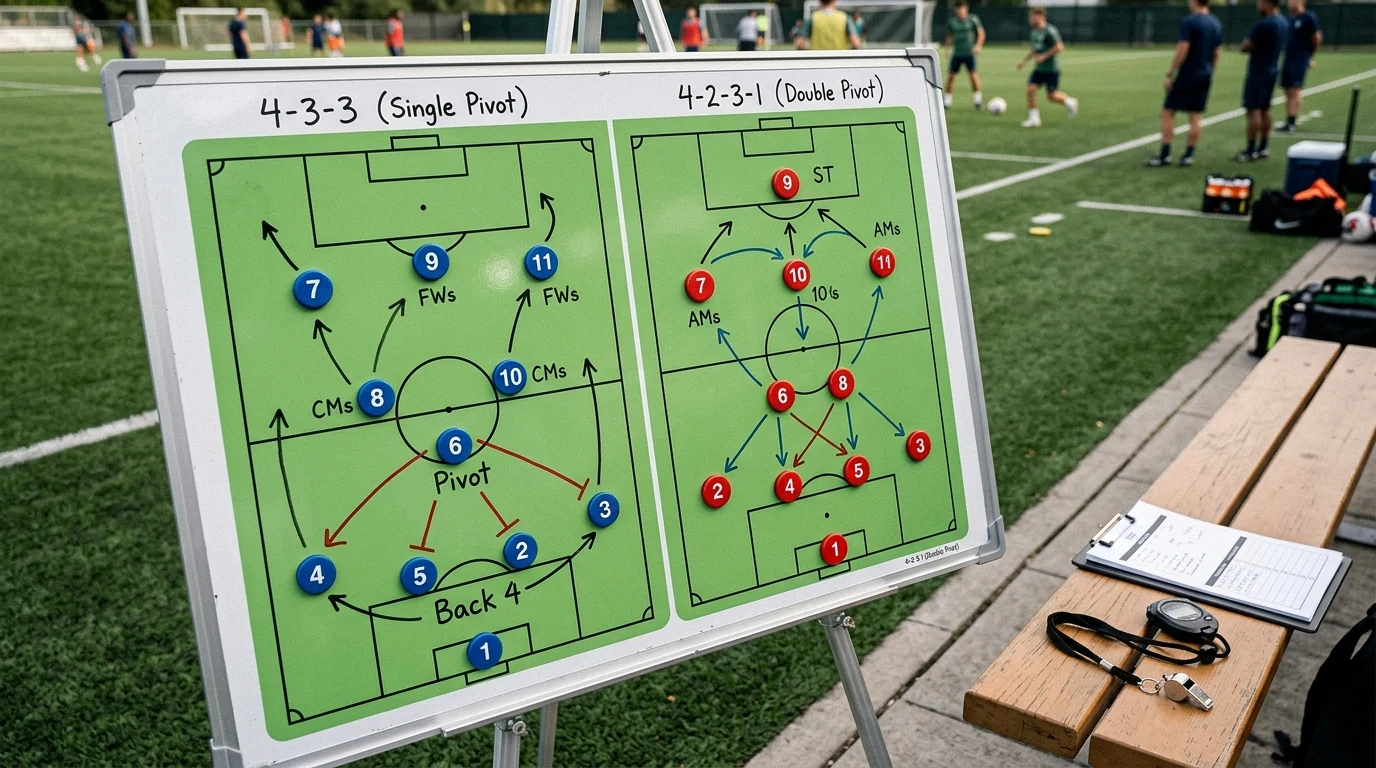
Tactical Dimensions: 4-3-3 vs 4-2-3-1 Comparative Matrix
| Tactical Dimension | 4-3-3 (Single Pivot) | 4-2-3-1 (Double Pivot) | Operational Impact on the Pitch |
|---|---|---|---|
| Midfield Triangle Geometry | Single #6 base with two inverted #8 attacking interiors (Inverted Triangle) | Two #6 holding pivots with a central #10 attacking apex (Flat Base Triangle) | 4-3-3 overloads half-spaces; 4-2-3-1 dominates central defensive shielding. |
| Defensive Pivot Demands | Single pivot must cover 30+ yards lateral width solo; highly vulnerable if bypassed | Shared workload: one pivot steps to press while the partner holds depth | 4-2-3-1 significantly reduces central fast-break concession risks. |
| Wing Overload & Width | Natural wide passing triangles formed by Fullback, Interior #8, and Winger | Width relies heavily on overlapping fullbacks as wide midfielders tuck inside | 4-3-3 establishes sustained wide pinning of opposition back four. |
| Pressing Architecture | Aggressive high press led by front three; locks opponent build-up to touchlines | Mid-block pressing trap; channels play into congested central double-pivot zones | 4-3-3 requires top-tier cardiovascular conditioning and synchronized pressing triggers. |
| Attacking Playmaker Space | No static #10; creative duties distributed between dual roaming #8s | Dedicated free-role #10 operating in the pocket between midfield and defense | 4-2-3-1 provides an intuitive focal point for finding incisive through-balls. |
| Grassroots & Youth Suitability | Teaches natural passing angles, spatial awareness, and rotational interchange | Easier to assign fixed defensive roles to developing players prone to losing shape | 4-3-3 develops superior tactical intelligence; 4-2-3-1 yields immediate defensive stability. |
1. Structural Geometry: Inverted Triangle vs Flat-Base Double Pivot
To understand why these systems behave differently on match day, coaches must examine their geometric building blocks. On a standard 105 × 68 meter pitch, soccer is fundamentally a game of occupying spatial corridors: the two wide channels, the two half-spaces (the channels between the flank and the center circle), and the central axis.
In the 4-3-3, the midfield operates as an inverted triangle. A single defensive midfielder (the #6) anchors the base directly in front of the center-backs. Ahead of the single pivot, two interior midfielders (the #8s) occupy the left and right half-spaces. Combined with the wingers and fullbacks, this layout naturally creates passing triangles across every zone of the pitch without requiring players to shift out of position.
In the 4-2-3-1, the midfield triangle is flipped. Two holding midfielders (often called the double pivot or doble pivote) sit side-by-side in front of the back four. Ahead of them sits a dedicated central attacking midfielder (the #10). This creates a flat defensive foundation of six outfield players (the back four plus the double pivot), freeing the front four to focus primarily on high-value attacking movements.
2. Deep Dive: Where the 4-3-3 Dominates the Pitch
When executed by disciplined squads, the 4-3-3 provides tactical advantages that few systems can match:
- Relentless Half-Space Penetration: Because the two #8s start higher up the pitch, they naturally occupy the pockets between the opponent’s central midfielders and wide defenders. When the opposition fullback steps out to mark our winger, the interior #8 immediately underlaps into the vacated channel, creating an instant 2v1 numerical overload.
- High-Intensity Counter-Pressing Rest Defense: When a 4-3-3 team loses possession in the final third, five players (the striker, both wingers, and both #8s) are already positioned within 15 meters of the ball. This tight spatial clustering allows for immediate gegenpressing within 3 to 5 seconds of a turnover, pinning the opponent inside their own penalty box.
- Wide Isolation for Dynamic Wingers: By pinning the opposing center-backs with a dedicated central striker (#9), the wingers receive diagonal balls in isolated 1v1 situations against fullbacks. For teams with explosive wing players, the 4-3-3 creates maximum runway to attack the penalty box.
The Fatal Vulnerability of the 4-3-3: The entire system relies on the technical and physical capacity of the single pivot (#6). If your #6 lacks lateral speed, positional discipline, or struggles under back-to-goal pressure, opponents will exploit the massive horizontal spaces on either side of the single pivot during fast transitions.
3. Deep Dive: Where the 4-2-3-1 Provides Superior Balance & Security
The 4-2-3-1 remains the most popular tournament formation in world football for clear structural reasons:
- Unbreakable Central Transition Defense: In a double pivot, both holding midfielders share spatial responsibility. When the right-sided pivot steps forward to contest a ball, the left-sided pivot automatically tucks in to cover the central corridor. This piston movement ensures the central zone directly in front of the center-backs is never left abandoned.
- Unlocking the Pure Creative #10: While the 4-3-3 requires all midfielders to participate in aggressive pressing and vertical box-to-box tracking, the 4-2-3-1 provides a platform for a pure visionary playmaker. Operating in the hole behind the striker, the #10 has freedom to drift between lines, combine with wide midfielders, and deliver defense-splitting through-balls.
- Fullback Freedom to Overlap: Because two holding midfielders protect the central axis, outside fullbacks can charge forward into attacking overloads without exposing the team to immediate counter-attack catastrophes. If the left-back overlaps, the left-sided #6 simply slides across to cover the vacant flank.
4. Pressing Triggers: High-Block Lock vs Mid-Block Trap
How each formation behaves without the ball reveals its defensive DNA:
- 4-3-3 High Press Trigger: The striker angles their run to block the pass between the opposing center-backs, forcing the ball toward one fullback. As soon as the pass is released to the wide defender, the ball-side winger sprints to lock the sideline, while the near-side #8 jumps onto the opposing midfielder. This suffocates all short passing outlets and forces desperate long clearances.
- 4-2-3-1 Mid-Block Trap: The team drops into a compact block between the center circle and defensive 18-yard box. The lone striker and #10 screen passes into the opposition’s defensive midfielders. When the opponent attempts a risky pass into the center, the nearest double-pivot midfielder steps forward with an aggressive tackle while the second pivot sweeps behind, winning second balls and initiating instant vertical counters.
For coaches transitioning between defensive structures, see our companion analysis on Zonal Marking vs Man-to-Man Marking Systems.
5. Coach Selection Matrix: Which System Fits Your Squad?
You Should Coach the 4-3-3 If:
- You have an intelligent, composed defensive midfielder (#6) who excels at scanning, receiving passes under pressure, and breaking lines.
- Your central midfielders (#8s) possess exceptional stamina (10–12 km per match work rate) and can arrive late in the box to score.
- You have true wide wingers who excel in isolated 1v1 situations against outside backs.
- Your center-backs are athletic and comfortable defending 35 yards from their own goal in a high defensive line.
You Should Coach the 4-2-3-1 If:
- Your squad lacks an elite solo defensive anchor, but you have two balanced, hardworking holding midfielders who complement each other.
- You have a stand-out creative attacking midfielder (#10) with visionary passing and shooting from distance.
- Your outside fullbacks love to push into attack and require defensive midfield screening behind them.
- Your team frequently concedes counter-attack goals when caught in possession.
6. In-Game Fluidity: How Modern Coaches Transition 4-3-3 into 4-2-3-1
Elite coaches in 2026 rarely treat formations as rigid, static lines. The most effective tactical teams fluidly oscillate between both systems based on match state and possession phases:
- Attacking Phase (In Possession): When building out from the back, a 4-2-3-1 frequently morphs into a 4-3-3 or 3-2-4-1. One of the double pivots pushes forward into the half-space, while the #10 drifts into wide overloads to create passing triangles.
- Defensive Phase (Protecting a Lead): When defending a one-goal advantage in the final 20 minutes, a 4-3-3 team can immediately instruct one of their #8s to drop alongside the single pivot, cementing a rigid 4-2-3-1 or 4-4-2 low block that clogs the central avenues to goal.
Frequently Asked Questions: 4-3-3 vs 4-2-3-1
What is the primary difference between a 4-3-3 and a 4-2-3-1 formation?
The fundamental difference lies in the midfield structure. A 4-3-3 uses a single defensive midfielder (#6) behind two central interior midfielders (#8s), creating an inverted triangle. A 4-2-3-1 uses two holding defensive midfielders (a double pivot) behind one dedicated central attacking midfielder (#10), prioritizing central defensive cover and dedicated playmaker positioning.
Which formation is better for youth soccer development (U11 to U16)?
The 4-3-3 is widely considered superior for player development because its geometry naturally creates passing triangles and teaches players to read space, rotate positions, and break lines. However, for developing teams struggling with defensive concessions on counter-attacks, the 4-2-3-1 provides a clearer, more secure defensive baseline that boosts team confidence.
Can a 4-3-3 beat a 4-2-3-1 head-to-head?
Yes. In head-to-head tactical matchups, a 4-3-3 creates a 3v2 overload on the flanks because the winger, fullback, and advanced #8 can gang up on the opposition’s isolated wide midfielder and fullback. Conversely, the 4-2-3-1 counters this by exploiting the space behind the 4-3-3’s advanced #8s, feeding the central #10 into the hole against the lone single pivot.
What physical attributes does a single pivot (#6) need in a 4-3-3?
A single pivot requires exceptional 360-degree vision, press-resistance, and rapid lateral agility. They must possess the stamina to cover 11+ kilometers per game, elite anticipation to intercept transitional passes before they reach the back four, and the passing range to switch play across 40 yards with two touches.
How do fullbacks play differently in a 4-3-3 versus a 4-2-3-1?
In a 4-3-3, fullbacks often play an inverted role or provide disciplined balance because the wingers already hug the touchlines. In a 4-2-3-1, because the wide midfielders frequently tuck inside to combine with the #10, the fullbacks must provide the team’s primary attacking width by executing lung-busting overlapping sprints down the touchline.
Explore Related Tactical & Coaching Blueprints
- Zonal Marking vs Man-to-Man Marking in Modern Soccer → How to structure set pieces and defensive blocks.
- How to Coach the 4-3-3 Formation: Step-by-Step Grassroots Guide → Download complete passing drill patterns and session plans.
- The 4-3-3 Pressing Triggers Playbook → Master defensive pressing angles and touchline traps.
- Nike Mercurial Superfly vs Adidas Predator Teardown → Choosing the right cleat profile for pace wingers vs playmaking pivots.
Get our latest guides, news, and insights highlighted in your Google Search & AI Overviews.