Every soccer fan knows the thrill of a tightly contested match can suddenly shift with the flash of a red card-dramatic moments that change the game’s rhythm and outcome. But what exactly warrants this ultimate sanction? This guide unpacks the rules behind red cards, exploring the fouls, misconduct, and heated decisions that send players off the field. Whether you’re a passionate supporter eager to understand referee calls, a player refining your game’s discipline, or simply curious about the sport’s fine line between fierce competition and fair play, this deep dive connects you to the heart of soccer’s most pivotal moments. Through vivid examples, player insights, and match narratives, we celebrate the drama and integrity that make soccer the stunning game it is indeed-while clarifying why a red card isn’t just a penalty, but a powerful statement on respect, safety, and the spirit of the sport. Join us as we journey beyond the whistle to reveal what truly demands a red card and why these moments resonate far beyond the 90 minutes.
Contents
- Understanding the Role and Impact of Red Cards in Soccer
- Key Impacts of a Red Card in Soccer
- The Official Rules Behind Red Card Offenses
- Understanding Key Sent-Off Offenses
- Common Fouls That Instantly Trigger a Red Card
- Examples of Fouls Leading to Immediate Red Cards
- Controversial Red Card Moments in Soccer History
- Lessons from Controversial Red Card Moments
- How Referees Decide When to Show a Red Card
- Factors That shape Red Card Decisions
- Tactical Consequences of Playing with a Red Carded Player
- Player and Coach Reactions to Red Card Decisions
- Real-World Reflections and Tactical Mindsets
- The Process and Implications of Post-Match Red Card Reviews
- Key Components of Post-Match Red Card Reviews
- Practical Advice for Navigating Post-Match Red Card Outcomes
- Red Cards Across Different Soccer Leagues and Tournaments
- Varied Disciplinary Procedures and Their Impact
- Training and Discipline: Avoiding Costly Red Cards
- key Strategies for Red Card Prevention
- Discipline as a Tactical asset
- How Red Cards Influence Team Strategy and Match Outcomes
- Practical Tactics for Handling a Red Card
- Emerging Trends in Red Card Enforcement and VAR Technology
- Key Evolutions Driving Change
- Faq
- Q: How does violent conduct lead to a red card in soccer?
- Q: What distinguishes serious foul play from a yellow card offense?
- Q: can denying a clear goal-scoring opportunity always result in a red card?
- Q: How does a second yellow card automatically turn into a red card?
- Q: When can a goalkeeper receive a red card for a foul?
- Q: Are red cards reviewed after the match and can decisions be overturned?
- Q: How does VAR technology impact red card decisions in modern soccer?
- Q: Why do some soccer leagues issue red cards more frequently than others?
- Key Takeaways
Understanding the Role and Impact of Red Cards in Soccer
Red cards are among the most powerful instruments in soccer, acting as critical turning points that can shift the momentum of a match instantly. their significance transcends mere punishment; a red card not only removes a player from the field but also alters the psychological and tactical dynamics of both teams. Historic examples such as Zinedine Zidane’s infamous 2006 World Cup final headbutt reveal how a single ejection can overshadow an entire career moment,galvanizing one side while crushing the hopes of the other. Players and coaches alike recognize that avoiding a red card is as much about emotional control and game intelligence as it is indeed about fair play, making this disciplinary tool a cornerstone of the sport’s integrity and drama.
Understanding the deeper impact of red cards requires appreciating how teams respond under pressure, especially when reduced to ten men.Match stories ofen highlight remarkable comebacks or heartbreaking collapses triggered by these moments. Coaches frequently emphasize resilience and strategic adjustments-shifting formations,managing stamina,and recalibrating aggression-to cope with the numerical disadvantage. Legendary defender Paolo Maldini once noted, “The red card teaches teams they must play smarter, not just harder.” For fans and players invested in the beautiful game’s layered narratives, red cards symbolize the fine line between passion-fueled brilliance and costly impulsivity. Learning to navigate this balance is vital for anyone wishing to grasp soccer’s competitive and emotional complexities.
Key Impacts of a Red Card in Soccer
- Numerical Disadvantage: Teams play with one fewer player, forcing tactical shifts.
- Psychological Shift: Players may feel increased pressure or embolden their opponent.
- Game Tempo Control: The team a player is sent off from frequently enough adopts a more defensive stance.
- long-Term Consequences: Suspensions affect team selection in subsequent matches.

The Official Rules Behind Red Card Offenses
A red card in soccer represents the ultimate disciplinary measure, reserved for actions that threaten the spirit of fair play, player safety, or the integrity of the game. According to the Laws of the Game as defined by the International Football Association board (IFAB), a player is sent off with a red card for offenses that are severe enough to warrant immediate dismissal-this ensures the match proceeds with respect for rules, fairness, and respect. These offenses are not just about rigid penalties; they keep the game’s intense passion in balance, reminding players and fans alike that certain boundaries, once crossed, change the game’s narrative irreversibly.
At its core, the rules identify several categories where a red card is compulsory, ranging from violent conduct to denying an obvious goal-scoring chance. This includes serious foul play, where reckless challenges endanger the opponent’s safety, and acts of aggression such as striking or spitting. The clarity of these rules allows referees to make decisive calls in high-pressure moments.Legendary referee Pierluigi Collina once emphasized, “What the red card does is not just stop unfairness-it protects the game’s beauty.” The clear request of these regulations ensures every match honors the competitive spirit while safeguarding the well-being of those on the pitch.
Understanding Key Sent-Off Offenses
- Serious Foul Play: Using excessive force or brutality when challenging for the ball, such as hazardous tackles or deliberate hurling of an opponent.
- Violent Conduct: Actions outside the flow of play like punching,elbowing,or headbutting,famously seen in Zinedine Zidane’s 2006 World Cup final expulsion.
- Denying a goal-Scoring Opportunity: Intentionally fouling an opponent to prevent a clear goal chance, including handball offenses or illegal tackles.
- Offensive or Abusive Language and Gestures: Verbal misconduct serious enough to deter sportsmanship and respect on the field.
- Second Caution (Double yellow): Accumulating two yellow cards for persistent infringement results in a red card, triggering immediate dismissal.
By understanding these regulations, players can better appreciate the line between aggressive competitiveness and unacceptable behavior. Coaches often stress discipline and emotional control as essential skills-too often, the loss of a player due to a red card becomes the story that defines a match’s outcome. Teams recognizing the weight of these offenses, like manager Pep Guardiola, have embraced training methodologies that blend technical skill with mental fortitude to maintain composure in critical moments. This blend of law, sport, and human drama makes the red card both a protective tool and a catalyst for some of the most gripping chapters in soccer history.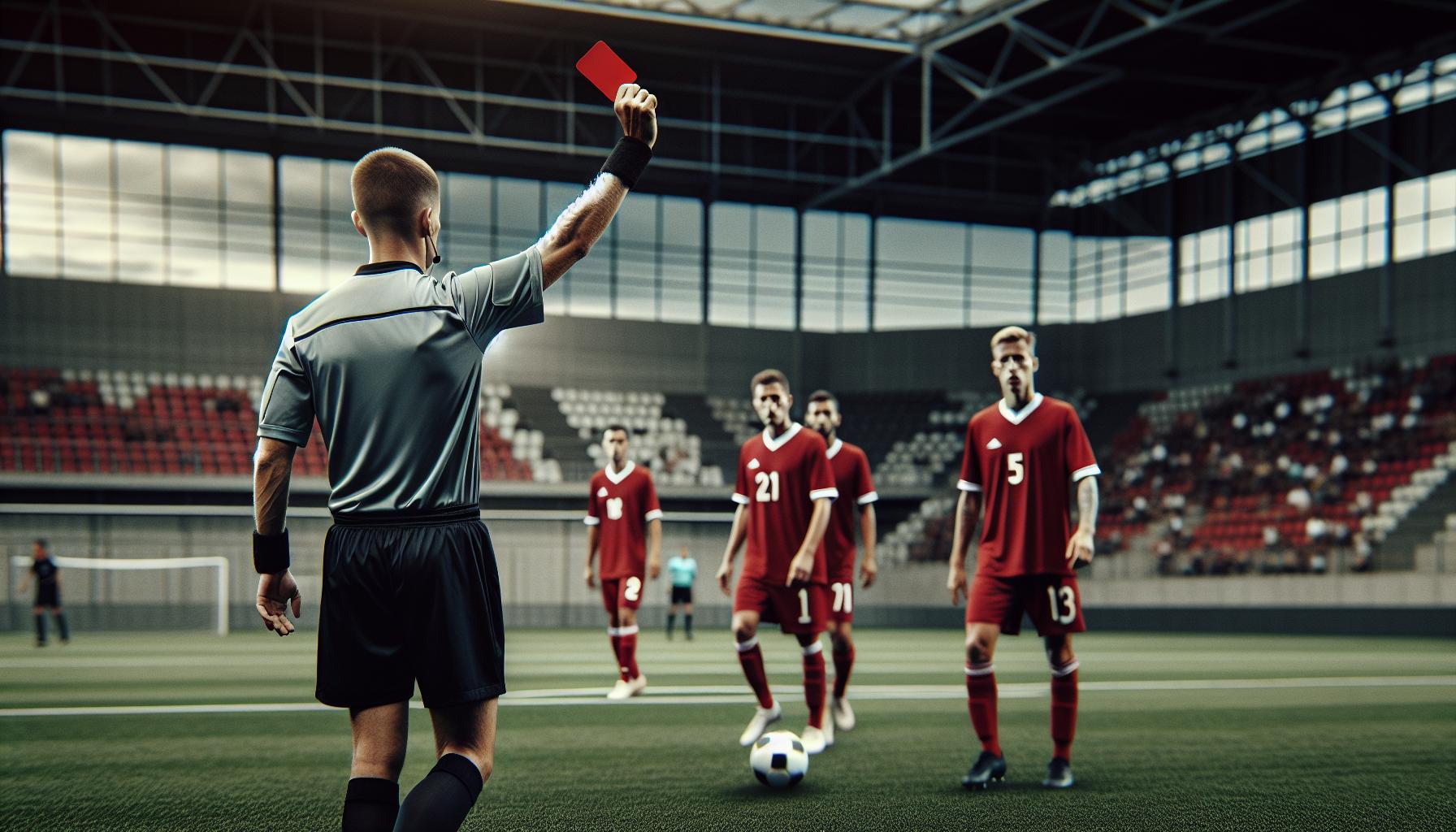
Common Fouls That Instantly Trigger a Red Card
Every intense soccer contest carries the risk of fiery moments where split-second decisions on the pitch can alter the outcome forever. Certain fouls cross a clear and immediate line - these offenses don’t just disrupt play, they threaten fairness and safety, compelling referees to reach straight for the red card. Understanding these triggers is essential not only for players striving to compete fiercely yet fairly but also for fans who crave the drama without chaos. From infamous tackles that ended careers to controversial handballs under the spotlight of a packed stadium, these fouls demonstrate the game’s uncompromising commitment to integrity.Among the most instantaneous red card offenses are those that involve blatant disregard for the opponent’s well-being or the rules’ spirit. Such as, serious foul play often appears as high, late tackles that risk injury - consider the excruciating moment when Nigel de Jong’s karate kick on Xabi Alonso in the 2010 World Cup final nearly fractured the midfielder’s ribs. Similarly, violent conduct extends beyond challenges for the ball: actions such as elbows, headbutts, or punches are unequivocally condemned, exemplified by Zinedine Zidane’s infamous 2006 World Cup final headbutt, which remains seared in football history. Then there is the strategic, yet illegal, denial of a clear goal-scoring opportunity, encompassing deliberate handballs or reckless fouls that rob teams of fair chances to win. These infractions ignite fierce responses on and off the pitch,with coaches frequently enough emphasizing situational awareness and composure to prevent costly dismissals.
Examples of Fouls Leading to Immediate Red Cards
- Serious Foul Play: Dangerous tackles lunged with excessive force-often with studs up or from behind-designed or recklessly risking harm.
- violent Conduct: physical aggression that lies outside the ball’s play, including fighting, biting, or spitting.
- Denying Obvious Goal-Scoring Opportunities: Illegal challenges or handballs that deliberately stop an opponent from scoring.
- use of Offensive or Abusive Language and Gestures: Intimidation and disrespect disrupting the spirit and decorum.
These clear-cut fouls serve both as warnings and boundaries to keep the beautiful game just that-beautiful. Legendary players and managers alike have stressed how discipline under pressure shapes champions. As Pep Guardiola once reflected, “Passion fuels us, but it must never blind us to respect and control.” Mastering when combativeness becomes culpable is where great players elevate the game beyond a mere contest of strength to one of skill,heart,and honor.
Controversial Red Card Moments in Soccer History
Few incidents in soccer ignite debate and emotion quite like a red card handed down under contentious circumstances.These moments frequently enough linger in collective memory, where a referee’s decision, seen by some as harsh or inconsistent, shaped the destiny of a match and sparked widespread discussion about fairness and the spirit of the game. Take Diego Maradona’s “Hand of God” goal in 1986-not a red card incident per se,but a reminder that officiating decisions can deeply influence football’s narrative. in the realm of red cards, similar watershed moments have not only altered scores but challenged the boundaries of interpretation, rule implementation, and sportsmanship. Players, coaches, and fans carry these moments as cautionary tales or rallying points for change in how the game is governed.
One of the most iconic episodes unfolded during the 2006 FIFA World Cup final when Zinedine Zidane received a red card for headbutting Marco Materazzi in extra time. This ejection was more than a disciplinary action; it was a seismic event that ended the career of a legendary player on the world’s biggest stage. Coach Marcello Lippi later reflected on the incident’s weight: ”It was heartbreaking, but it taught us all the immense power of discipline amidst pressure.” These moments underscore the sharp razor-edge on which professional players balance passion and control. Another case is Luis Suárez’s handball on the goal line during the 2010 World Cup quarter-final, a tactical foul that earned him a red card but ultimately facilitated Uruguay’s progression-raising debates about sportsmanship versus strategic sacrifice.In these instances, controversy pulses through the crowd and broadcasts, but they also highlight the referee’s crucial role in maintaining fairness despite intense pressure. Awareness of these past flashpoints helps players and coaches prepare mentally and tactically to avoid actions that can irreversibly tip the scales against their side.
Lessons from Controversial Red Card Moments
- Discipline Under Pressure: Maintaining composure in high-stakes scenarios proves essential; emotional reactions often lead to costly dismissals.
- Referee Interpretation: Players must understand that referees’ perspectives can vary widely, and incidents might potentially be judged differently across leagues and tournaments.
- Strategic Fouling Risks: While some red cards stem from deliberate tactical decisions, such as stopping a clear goal-scoring opportunity, these come with severe consequences that must be weighed carefully.
- Post-Match Reviews Matter: Modern technologies like VAR have introduced layers of review aiming to minimize controversy but also add complexity to in-game decisions.

How Referees Decide When to Show a Red Card
Every second on the pitch pulses with potential consequences, and referees wield the red card as the ultimate arbiter’s tool-a decision born not from haste, but from a complex blend of judgment, experience, and interpretation of the game’s spirit. Before reaching for that decisive red card, officials assess multiple factors instantaneously: the severity of the offense, the intent behind the action, and its impact on the flow and fairness of the match. Referees are trained to look beyond a simple foul; they consider whether the play endangered player safety, denied a clear goal-scoring chance, or exhibited violent conduct. this nuanced evaluation reflects the delicate balance between maintaining order and preserving the fluid excitement that defines soccer’s global appeal.
Technology like VAR has ushered in a new era of scrutiny,giving referees a vital second glance at contentious moments,yet the core responsibility remains with the on-field official.Legendary referee Pierluigi Collina famously emphasized that a red card must be “clear and obvious” in nature to justify dismissing a player during such emotionally charged moments. The decision also demands managing an invisible audience-the players, coaches, and thousands of fans-whose understanding of fairness hinges on transparency and consistency. Coaches often highlight how referees’ interpretations of aggression and tactical fouls vary across leagues, reminding teams to adapt accordingly. As former England striker gary Lineker once reflected, “The red card is a game-changer, but it is the referee who must decide if the game is better served by punishment or by keeping players on the pitch.”
Factors That shape Red Card Decisions
- Severity and Intent: Deliberate violent conduct or reckless challenges carry strong red card signals.
- Location and Game Context: Fouls preventing clear goal-scoring opportunities near the penalty area often trigger harsher punishment.
- Player History and Match Temperature: Officials note if a player has previous cautions or if the match atmosphere is volatile.
- Use of VAR: Video replay allows referees to confirm or overturn decisions, reducing mistakes but heightening pressure.
When referees decide to show the red card, they are not merely enforcing rules-they are shaping the narrative of the match itself. Their calls resonate beyond the pitch, influencing team morale, tactical shifts, and even post-match discourse. Understanding this intricate decision-making process enriches our recognition for the humanity and expertise required behind every dramatic sending-off.
Tactical Consequences of Playing with a Red Carded Player
A team reduced to ten men faces an immediate and profound shift in the dynamics of the game-one that challenges coaches and players to adapt swiftly under pressure. Playing with a red carded player is often more than a numerical disadvantage; it forces a reimagining of roles, formations, and strategies to compensate for the lost presence. History offers vivid illustrations, from Liverpool’s resilient 2005 Champions League final comeback after losing Luis García to a red card, to Leicester City’s remarkable Premier League survival campaigns where tactical discipline under duress became their hallmark. As Chelsea manager Thomas Tuchel once remarked, “When you loose a player, you don’t just lose numbers-you lose the rhythm, the flow, and the spirit that binds the team.” This loss reverberates across every facet of gameplay, demanding tactical ingenuity and mental toughness.
Teams often transition to more compact formations to shore up defensive stability while seeking moments to counterattack effectively. Coaches might switch from an aggressive four-forward line to a more conservative 4-4-1 shape, prioritizing coverage of critical spaces and reducing exposure on the flanks. the most successful sides use this handicap to harness collective energy, often rallying around their depleted ranks with intensified dialog and trust. Key principles come into focus:
- Spatial Management: Players must communicate precise positioning to avoid leaving dangerous gaps.
- Energy Conservation: Intensive defensive work requires strategic substitutions to maintain stamina.
- Selective pressing: Avoid overcommitting players forward, which could invite overwhelming pressure.
These tactical recalibrations not only mitigate the damage wrought by the sending-off but sometimes unlock unexpected resilience, transforming adversity into a catalyst for iconic team spirit moments. Defenders like Carles Puyol and Javier mascherano have championed the mindset of turning short-handed situations into heroic standpoints, embodying the unyielding heart of soccer. Ultimately, navigating the tactical consequences of a red card is a testament to soccer’s blend of strategy, emotion, and human will.
Player and Coach Reactions to Red Card Decisions
Red card decisions in soccer are rarely met with quiet acceptance; they ignite an intense wave of emotions that ripple through players, coaches, and fans alike. The immediate reaction on the pitch often reveals raw passion-players may express disbelief, frustration, or even remorse, while coaches rally their squads to refocus despite the sudden setback. One of the most striking moments in recent history unfolded during the 2010 FIFA World Cup quarterfinals when England’s Wayne Rooney received a red card, instantly altering the team’s dynamic. Rooney later admitted, “It was a moment I wish I could take back, but it also forced the team to dig deeper, to find strength in adversity.” These responses highlight the human element behind the rules-a reminder that each red card carries personal and collective consequences that transcend the referee’s whistle.
Understanding how players and coaches channel these reactions into productive outcomes is crucial for teams seeking resilience. Coaches frequently enough act as the emotional anchors during these moments, blending tactical adjustments with motivational leadership. José Mourinho, known for his fiery passion and tactical acumen, has frequently emphasized the importance of maintaining composure after sending-offs: ”It’s not just about who leaves the pitch; it’s about how the eleven remaining respond-mentally and physically.” Practical advice for teams dealing with red cards includes fostering open communication, maintaining clear roles under pressure, and using the adversity as a rallying point to galvanize team spirit. Players are encouraged to control their emotions to avoid further disciplinary actions, while coaches must swiftly recalibrate strategies to leverage the team’s collective focus.
Real-World Reflections and Tactical Mindsets
- Player Outlook: Emphasizing accountability, learning from mistakes, and viewing the red card as a catalyst for personal growth.
- Coach Strategy: Balancing frustration with calm leadership to restructure formations and inspire unity.
- Fan Reactions: Appreciating the emotional complexity and respecting referees’ tough decisions amid split-second judgments.
The most successful responses to red cards combine tactical discipline with emotional intelligence, showcasing soccer’s beauty as a sport that challenges minds and hearts concurrently. Whether it is indeed a veteran leader like Carles Puyol rallying a short-handed Barcelona or a rising star like Marcus Rashford channeling frustration into heroic efforts, these moments remind us why red cards-while punitive-are integral to the drama and passion that define the game.
The Process and Implications of Post-Match Red Card Reviews
Few moments in soccer spark as much debate and drama as a red card handed after the final whistle. while on-field decisions are subject to instantaneous judgment calls, post-match red card reviews open a crucial dimension where the integrity of the game meets thorough scrutiny. Governing bodies and disciplinary panels meticulously analyze match footage, frequently enough leveraging VAR technology and multiple camera angles to ensure that justice is served beyond the heat of competition. This process serves not only to confirm or overturn controversial calls but also to uphold fair play, providing teams and fans a pathway to contest what may have felt like an unjust punishment. The high-profile case of Luis Suárez’s red card appeal during the 2014 world Cup exemplifies this: the Uruguayan striker’s challenge was intensely reviewed, leading to a nuanced understanding of intent and contact that influenced the final disciplinary ruling.This thorough examination carries weighty implications that extend beyond individual player sanctions. Post-match reviews can alter suspensions, financial penalties, and even team morale, affecting subsequent fixtures and tactical plans. Coaches, in particular, navigate this uncertainty by preparing their squads mentally and tactically for possible lineup changes. Players,meanwhile,often view the review period as a chance for redemption or a call to accept accountability,a dynamic vividly reflected by former Chelsea defender John Terry’s response to his retrospective red card: “It’s tough sitting on the sidelines knowing there’s a chance to change the outcome,but you learn to turn patience into motivation.” Teams benefit from understanding the distinct appeals procedures across leagues and tournaments, which vary in transparency and timeline but share a common goal-to balance competitive passion with rule enforcement.For fans and analysts alike, these reviews deepen appreciation for soccer’s layered narrative, where split-second decisions resonate far beyond the final whistle.
Key Components of Post-Match Red Card Reviews
- Video Evidence Assessment: Utilizing VAR and multi-angle footage to clarify incidents missed or misjudged during play.
- Disciplinary Committee Deliberations: Panel discussions incorporating referee reports, player testimonies, and expert opinions.
- Appeal Frameworks: Offering teams and players procedural steps to contest or accept decisions, varying by governing body.
- sanction Adjustments: Potential modification of bans or fines based on review findings.
- Maintain clear communication between coaching staff and players to prepare for the possibility of extended suspensions.
- Engage legal or disciplinary experts familiar with league-specific protocols to enhance appeal effectiveness.
- Use review periods as opportunities for team meetings focused on resilience and strategic adjustments.
- Encourage players to reflect on the incident constructively, fostering growth rather than resentment.
Red Cards Across Different Soccer Leagues and Tournaments
Few moments in soccer ignite as much passion and debate as a red card issued during high-stakes matches across the world’s top leagues and tournaments. While the core principles behind sending-off offenses remain consistent under FIFA’s Laws of the Game, practical application can vary notably depending on the competition’s culture, referee emphasis, and disciplinary frameworks. For example, in European leagues like the English Premier League and La Liga, referees often demonstrate a blend of strict enforcement and contextual leniency – mindful of both the flow of the game and player safety. This contrasts with tournaments such as the UEFA Champions League, where the spotlight of global viewership and higher scrutiny encourages officials to strictly apply rules, especially concerning violent conduct or dissent. Iconic incidents like Diego Costa’s fiery expulsions in Spain and the rigorous clampdown on tactical fouls in serie A underscore how player behavior and league philosophies shape red card dynamics uniquely within each ecosystem.
Varied Disciplinary Procedures and Their Impact
The procedural handling of red cards-both during and after matches-also reveals fascinating diversity. Major tournaments like the FIFA World Cup and the UEFA European Championship employ centralized disciplinary panels empowered to review incidents post-match with enhanced video technology, sometimes overturning or extending sanctions based on new evidence. clubs in domestic leagues, though, navigate specific appeal windows and may face varying levels of transparency. As Gareth Southgate once noted during his coaching tenure, “Understanding how and when to challenge a red card isn’t just about fairness – it’s about protecting the team’s future.” Players and coaches must familiarize themselves with these nuances to ensure that red card penalties don’t derail competitive aspirations. For fans and analysts, appreciating these layers enriches the narrative-every dismissal carries a ripple effect, influencing not just the 90 minutes on the pitch but also tactical planning, player morale, and the broader contest for silverware.
- Practical advice for clubs: Build strong relationships with disciplinary committees, and cultivate a clear process for appeals to maximize chances of reducing sanction duration.
- For players: Maintain composure to avoid impulsive infractions especially in leagues where repeat offenses trigger escalating penalties.
- Coaches shoudl: Prepare tactical contingency plans to adapt seamlessly to sudden player dismissals, which vary in occurrence across different competitions and refereeing styles.
- Fans and commentators: Embrace the context behind each red card, recognizing how cultural and operational factors distinguish leagues, thus deepening appreciation for the game’s evolving complexity.
| League / Tournament | Refereeing Style | Post-Match Review | Notable Red Card Trend |
|---|---|---|---|
| English Premier League | Physical, balanced enforcement | Club appeals common, transparency moderate | Strict on violent conduct, tactical fouls debated |
| UEFA Champions league | Strict, media spotlight intensifies decisions | Centralized disciplinary panel, VAR-driven | Low tolerance for dissent, high-impact decisions |
| Serie A (Italy) | technical, emphasis on tactical discipline | Appeals allowed, with some discretion on violent conduct | Focus on professional fouls and simulation |
| FIFA World Cup | Highly scrutinized, consistent with law | Post-match reviews affect suspensions globally | Few red cards, but massive consequences |
Embracing these differences not only sharpens strategic awareness for teams but also elevates the collective passion of the soccer community, where every red card writes a story of its own - a dramatic pivot in the eternal dance of competition, courage, and result.
Training and Discipline: Avoiding Costly Red Cards
Few moments prove more costly to a team than a red card pivoting the game’s flow and momentum, often changing the story written on the pitch within minutes. Avoiding such perilous situations requires a blend of disciplined training, mental fortitude, and clear understanding of the rules among players and coaching staff alike. Legendary managers like Sir Alex Ferguson and Pep Guardiola have long emphasized that mastery of emotional control is as vital as technical skill. As Ferguson once remarked, “The best players are those who play with passion but never lose their composure-aggression without discipline is a recipe for disaster on any pitch.” Training sessions that incorporate scenario-based drills, focusing on split-second decision-making and restraint in high-pressure moments, empower players to recognize potential flashpoints before they erupt into refereed expulsions.
building a culture of discipline means embedding awareness of red card consequences into daily routines, from youth academies to professional setups. Coaches who immerse their teams in simulated match conditions, highlighting borderline tackles and dissent that invite harsh scrutiny, see fewer costly dismissals over a season. Incorporating video analysis of past red card incidents-both within their own ranks and from global leagues-offers invaluable lessons; players better appreciate not only what actions to avoid but the ripple effect of a single moment’s lapse. For instance, watching how Sergio Ramos’s fiery temperament sometimes resulted in vital red cards teaches a balanced approach: competitive fire fueled by strategic self-control.
key Strategies for Red Card Prevention
- Emphasize Emotional Intelligence: Training to recognize triggers and diffuse tension can prevent rash fouls or confrontations.
- Rules Education: Regular workshops updating players on evolving interpretations under VAR and league-specific disciplinary nuances.
- Scenario Drills: Simulating high-stakes moments that test decision-making under fatigue and pressure.
- Peer Accountability: encouraging leaders on and off the pitch to set behavioral standards and mentor younger teammates.
Discipline as a Tactical asset
Discipline extends beyond avoiding punishment-it’s a weapon that molds team reliability and psychological endurance. Coaches like Jürgen Klopp have lauded disciplined aggression as the spine of their pressing systems. “When players know they can trust each other to maintain focus, play hard but fair, the entire squad breathes easier,” Klopp explained. In this light, avoiding red cards isn’t mere rule compliance; it safeguards physical resources, emotional momentum, and tactical versatility. Those teams that master this delicate balance frequently leverage it into consistent success, sustaining intensity without sacrificing composure.
| Training Focus | Benefit | Example |
|---|---|---|
| Emotional management under pressure | Reduces impulsive challenges and dissent | Barcelona’s youth academy programs |
| Referee communication drills | Improves understanding of boundaries and respect | Premier League clubs’ preseason workshops |
| Game situation simulations | Better in-match decision-making | Bayern Munich’s tactical training sessions |
Ultimately, fostering discipline and awareness transforms red card avoidance from a reactive necessity into a proactive strategic edge. Players rising to this challenge add not only to their professional longevity but also elevate the collective artistry and drama that make soccer the beloved spectacle it is worldwide.
How Red Cards Influence Team Strategy and Match Outcomes
Few moments in soccer demonstrate the razor-thin line between triumph and despair quite like the issuance of a red card. When a player is sent off, the game’s landscape shifts almost instantly-leaving teams to navigate the challenge of being a man down, often for the remainder of the match. The strategic repercussions echo far beyond the immediate physical disadvantage; teams must swiftly recalibrate their formation,alter pressing triggers,and recalibrate risk tolerance. Legendary coach José Mourinho once noted, “A red card is not just about numbers; it’s a psychological blow that demands courage and ingenuity to overcome.” This sentiment encapsulates how coaches and players alike must rise to meet these sudden tactical upheavals, blending resilience with adaptation to preserve competitive edge.
navigating the aftermath involves more than just defensive fortification. Teams often pivot to a compact, counter-attacking setup, conserving energy and space while waiting for opportune moments to strike-classic examples include Leicester City’s remarkable 2016 Premier League run where strategic discipline under numerical inferiority was pivotal. Conversely,some squads opt for bold reshaping,as seen in the 2010 FIFA World Cup semifinal when the Netherlands,despite a red card,maintained aggressive pressing and eventually triumphed. This fluidity in approach highlights that red cards can galvanize a team’s tactical identity rather than simply restrict it. The psychological aspect cannot be overstated: players harnessing collective resolve frequently enough transform adversity into an electrifying showcase of determination.Coaches emphasize maintaining composure under pressure, encouraging players to communicate more frequently and cover for each other’s zones.
Practical Tactics for Handling a Red Card
- Reinforce Defensive Shape: Prioritize numerical superiority in key defensive zones to limit opposition breakthroughs.
- Energy Management: Rotate pressing responsibilities to avoid early fatigue in a reduced squad.
- Quick Transitions: Exploit spaces left behind by attacking players pressing forward, turning defensive phases into attacking opportunities.
- Communication & Leadership: Increase on-field dialogue, with captains and seasoned professionals guiding positioning and mindset.
| Tactical Adjustment | Goal | Example |
|---|---|---|
| Shift to a 4-4-1 formation | Maintain midfield control and compactness | Arsenal effectively under Arsène Wenger when down a man |
| Deploy a sweeper keeper | Compensate for lost defender by proactive goalkeeping | Manuel Neuer in Bayern Munich’s 2013 Champions League campaign |
| Increase counter-attack focus | maximize effectiveness in quick transitions | Leicester City’s 2015-16 Premier league season |
Ultimately, facing a red card compels teams to unveil the raw essence of soccer’s drama-a test of unity, strategic acumen, and resilience.Far from simply hindering a team, a well-managed red card scenario can become a defining moment, showcasing the sport’s glorious unpredictability and the human spirit that drives it. As legends have shown, it’s not just the eleven on the pitch who matter; it’s the collective heart and tactical wisdom that transform a setback into a battlefield triumph.
Emerging Trends in Red Card Enforcement and VAR Technology
Few developments in modern soccer have generated as much debate and transformation as the integration of Video Assistant Referee (VAR) technology into the adjudication of red card offenses. This innovation is reshaping the very fabric of how discipline is enforced on the pitch, providing referees with a crucial second look that can confirm or overturn critical decisions in real time. The ripple effect is profound: players now navigate a landscape where clear and obvious errors are more likely to be corrected, while teams regain a stronger sense of fairness and accuracy in high-stakes matches. As Chelsea’s captain Cesar Azpilicueta remarked after a crucial weekend game, “VAR doesn’t take the flair away; it just makes sure the game is played on the right terms.” This emerging era emphasizes precision, tempered with the understanding that soccer’s emotional and spontaneous nature remains vital to its drama.
Yet, beyond the technology itself, a trend towards more consistent, transparent, and educative enforcement has begun to crystallize. Leagues and governing bodies increasingly publish detailed reviews of red card incidents,explaining the rationale behind VAR decisions and referee judgments. This level of accountability fosters trust between officials, players, and fans while reducing confusion over sometimes controversial calls. Coupled with targeted referee training focused on interpreting VAR footage under pressure, the system encourages a smarter approach to discipline-one that balances toughness with fairness. Teams have begun adapting their tactics accordingly,knowing that reckless challenges are less likely to be overlooked and that maintaining composure is more crucial than ever.
Key Evolutions Driving Change
- Enhanced Referee Collaboration: On-field officials and VAR teams engage dynamically, ensuring swift and thorough reviews that minimize disruption.
- Video Evidence Standardization: Consistent criteria are set for reviewing red card offenses, reducing subjective interpretations across competitions.
- Player Behavioral Adjustment: Awareness of VAR’s watchful eye has led to a decline in risky tackles and dissent, promoting cleaner play.
- Communication with Fans: Expanded use of stadium screens and broadcast explanations allow supporters to follow VAR decisions transparently.
| Innovation | Impact | Example |
|---|---|---|
| Live VAR communication | Real-time clarity for teams and viewers on decisions | English Premier League’s introduction of public announcements during reviews |
| Post-Match Video Analyses | Improved referee training and public understanding | UEFA’s weekly referee review sessions using VAR footage |
| AI-Assisted Offense Detection (Future Trend) | Potential for pre-emptive alerts to referees for serious fouls | Early trials in lower leagues and youth tournaments |
Far from diluting soccer’s passion, these trends underscore an evolution toward a game that honors justice and integrity without sacrificing its pulse-pounding intensity. The fusion of human judgment and cutting-edge technology propels soccer into a new age-one where red cards are not just penalties but carefully calibrated instruments of fair play that reflect the sport’s relentless quest for balance between discipline and drama.
Faq
Q: How does violent conduct lead to a red card in soccer?
A: Violent conduct results in an immediate red card when a player uses excessive force or aggression against an opponent or even a bystander without contest for the ball. This includes punches, kicks, or headbutts. Recognizing such acts helps teams maintain discipline-explore how referees weigh these moments in our How Referees Decide When to Show a Red Card section for deeper insight.
Q: What distinguishes serious foul play from a yellow card offense?
A: Serious foul play involves reckless or overly forceful challenges that endanger player safety, triggering a red card instead of just a caution. Unlike minor fouls, these actions threaten injury or game integrity, requiring immediate dismissal. Learn more about these nuances in our Official Rules Behind Red Card Offenses discussion.
Q: can denying a clear goal-scoring opportunity always result in a red card?
A: Yes, denying an obvious goal-scoring chance by fouling or handling the ball deliberately outside the goal area typically leads to a red card. Though, rare exceptions apply if the foul is a genuine attempt for the ball. For tactical shifts when a player is sent off, see Tactical Consequences of Playing with a Red Carded Player.
Q: How does a second yellow card automatically turn into a red card?
A: A player who receives two yellow cards in a single match is promptly shown a red card and sent off. This cumulative penalty enforces discipline and game fairness. Understanding player conduct and coach reactions around this can be found in Player and Coach Reactions to Red Card Decisions.
Q: When can a goalkeeper receive a red card for a foul?
A: Goalkeepers can be red-carded for violent conduct, denying a clear goal-scoring chance, or handling the ball outside their penalty area illegally. Their unique role requires strict adherence to rules, affecting team defense significantly.Check out how Red Cards Influence Team Strategy and Match Outcomes for more.
Q: Are red cards reviewed after the match and can decisions be overturned?
A: Yes, post-match red card reviews by disciplinary committees or VAR can confirm, reduce, or rescind red cards based on video evidence and context. This process aims to ensure fairness and uphold the sport’s integrity. see our Process and Implications of Post-Match Red Card Reviews for detailed examples and procedures.
Q: How does VAR technology impact red card decisions in modern soccer?
A: VAR assists referees by providing video footage to review potential red card offenses, often reducing mistakes and controversial calls on violent conduct or serious fouls. It adds transparency and accuracy but also changes game dynamics-explore the latest developments in Emerging Trends in Red Card Enforcement and VAR Technology.
Q: Why do some soccer leagues issue red cards more frequently than others?
A: Variations in red card frequency across leagues arise from differing referee strictness,playing styles,and competition intensity. Some leagues emphasize aggression control more strictly, influencing team discipline strategies. For a global perspective, check out Red Cards Across Different Soccer Leagues and Tournaments.
Explore these insights to deepen your understanding of red card offenses and elevate your appreciation of soccer’s drama and discipline. Dive into the full guide to experience vivid match breakdowns, legendary player moments, and passionate community stories.
Key Takeaways
Understanding what warrants a red card in soccer not only deepens your appreciation for the game but also sharpens your insight into those pivotal match moments that define players’ legacies.From tactical fouls that shift momentum to high-stakes challenges that test a player’s discipline, the red card remains one of the sport’s most impactful decisions. for a closer look at the finer points of disciplinary actions, don’t miss our articles on yellow card rules explained and key referee signals decoded, where expert analysis brings these critical moments to life.
Ready to elevate your soccer knowledge even further? Dive into our coach interviews and player profiles to see how top professionals navigate the pressures that lead to such game-changing calls. Subscribe to our newsletter for insider tips, historical match breakdowns, and the latest updates from the world of soccer. Join the conversation below-share your thoughts on the most controversial red cards and stay tuned for future explorations into fouls, penalties, and fair play dynamics that every fan should know. Your journey to mastering the beautiful game starts here.